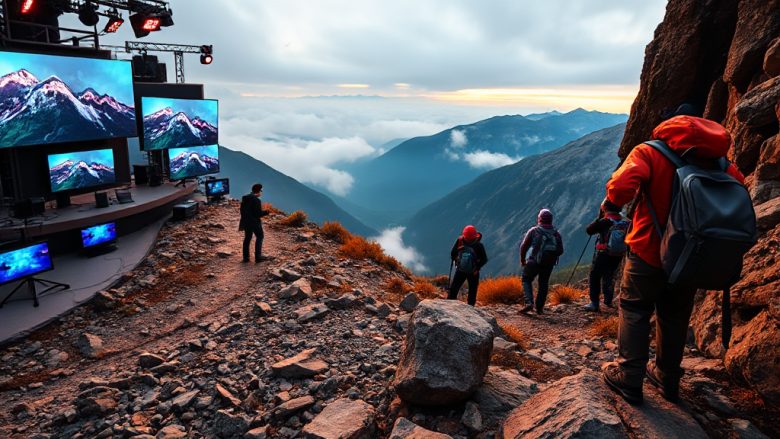
Stand at a popular trailhead on a Saturday morning and the shift is obvious. The car park fills before eight. Half the people setting off are wearing shoes that look like running trainers but grip like approach shoes. A few carry trekking poles that fold down smaller than a water bottle. Someone checks a watch that shows not just distance but a live weather radar and an avalanche risk band. Five years ago, that scene looked different. The gear was heavier, the information was thinner, and the crowds were smaller.
This is not a roundup of everything being marketed to hikers. Plenty of the loudest products solve problems nobody actually has. What follows is a set of mountain hiking trends to watch in 2026 that are already visible on real trails, backed by what trail crews, gear repairers and access officers are quietly dealing with. Some are welcome. A few deserve scepticism. All of them will shape how you plan a day out in the hills.
1. Smarter Fabric, Lighter Packs — and the Repair Culture Fighting Back
The biggest change in mountain hiking kit is not a new category. It is the quiet improvement of the materials already in your pack. Membrane fabrics that once felt like wearing a crisp packet now breathe properly and survive a full day of driving rain. Foam in sleeping mats is thinner but warmer. Dyneema-reinforced packs weigh less than a laptop and carry a week of food.
What makes 2026 different is that the weight savings have stopped being the headline. Hikers have noticed that ultralight gear often fails early, and the industry has responded. Repair services are appearing in outdoor shops that previously only sold. Zips get replaced, buckles get swapped, and a torn shell gets patched rather than binned. Trail crews I have spoken to say the litter they pick up has shifted from plastic bottles to broken plastic buckles and snapped carbon pole sections — a small but telling sign that cheap lightweight gear has a cost.
The smart move is not to chase the lightest possible setup. It is to buy the lightest setup you can actually maintain. A pack that weighs 300 grams more but has a replaceable hip belt will outlast three featherweight rivals. Look for gear with standard buckles, replaceable straps and a repair path. If a brand cannot tell you how to fix its product, that tells you something about how long it expects you to keep it.
What this means for you
Before your next big hill day, audit what you already own. Can the zip be fixed? Is the sole still bonded? A ten-minute repair beats a hundred-pound replacement, and it keeps serviceable kit out of landfill. When you do buy, weight matters less than whether the item can be repaired by a normal person with a normal sewing kit.
2. Trail Etiquette Is Getting Formal — and That Is a Good Thing
Trails are busier than they have ever been in the shoulder seasons, and the old unwritten rules are straining. The result is that etiquette is becoming explicit. Land managers are posting clearer guidance at trailheads: who yields to whom on a narrow climb, how far to keep dogs from livestock, where wild camping is genuinely tolerated and where it is not.
This is not bureaucratic fussiness. Erosion on popular mountain paths is measurable, and it is often caused by walkers cutting switchbacks or spreading off the line of a path to avoid mud. A path that is 30 centimetres wide and braided into five parallel tracks erodes roughly five times faster than a single well-drained line. Trail crews would rather you walk straight through the middle of a muddy patch than widen the damage around it.
The etiquette shift also covers sound and light. Speakers on trails are increasingly frowned upon, and rightly so. Headtorches pointed at other people’s eyes on a pre-dawn start are a genuine nuisance. None of this is about policing enjoyment. It is about keeping the hills usable for the numbers now turning up.
What this means for you
Read the signage at the trailhead rather than assuming you know the local conventions. On a narrow path, the uphill walker generally has right of way, but the real rule is to be predictable and to communicate. Step to the downhill side, keep your dog close, and walk through the mud rather than around it. Small habits, big difference over a season.
3. Navigation Tech That Complements, Not Replaces, the Map
Phone-based navigation has been the default for years, and the failure modes are well known: dead battery, cracked screen, no signal, a route line that quietly leads onto a cliff. In 2026, the more interesting trend is hybrid navigation. Watches with offline topo maps, satellite messaging built into mid-range handsets, and apps that cache entire regions before you leave the house are becoming normal rather than premium.
What is genuinely useful is the shift from turn-by-turn directions to terrain awareness. Newer tools show gradient, aspect and estimated time based on your own pace rather than a generic average. Some overlay recent satellite imagery so you can see whether a path is a real path or a faint scar that disappears in heather. That is a real improvement over a blue line on a blank screen.
What deserves scepticism is the promise of safety through technology. A satellite messenger does not make you competent. An app that rates a route as moderate has never met you, your fitness or the weather on the day. The hikers getting into trouble are not the ones without gadgets; they are the ones who trusted a gadget over their own eyes.
What this means for you
Carry a paper map and a compass, and know how to use them, even if you never do. Treat your phone as a backup that happens to be convenient, not as your primary navigation. Download the map area before you leave signal, carry a power bank in cold weather, and keep the device warm inside a layer rather than in an outside pocket.
4. Access, Permits and the Quiet Squeeze on Wild Camping
The least glamorous trend is also the one most likely to affect your plans. Access arrangements in popular mountain areas are tightening. Some of this is formal: permit systems for busy summits, seasonal restrictions to protect nesting birds or fragile vegetation, and clearer rules on where vehicles can park overnight. Some of it is informal: landowners who once turned a blind eye to roadside camping are now putting up signs.
The drivers are straightforward. Visitor numbers have risen faster than the infrastructure to absorb them. Parking at popular trailheads overflows into villages, and the resulting friction leads to restrictions that affect everyone, including the considerate majority. Trail crews report that the single biggest cause of new closures is not vandalism but human waste and litter at informal camping spots.
The counter-trend is community stewardship. Volunteer path repair days are oversubscribed in many areas, and hikers are increasingly willing to pay a small voluntary contribution toward path maintenance. That goodwill is the best argument land managers have for keeping access open rather than restricting it.
What this means for you
Check access rules before you travel, not when you arrive. Assume that wild camping is restricted unless you have confirmed otherwise. Use designated parking even if it adds a kilometre to your walk. Carry out everything you carry in, including food waste, and if you are camping, bury human waste properly or pack it out where required. Access is not a right that maintains itself.
5. Weather Windows, Acclimatisation and the New Realism About Risk
Mountain weather has always been changeable, but the patterns are shifting in ways that matter for planning. Longer dry spells interrupted by more intense rainfall mean that a route can be bone dry one week and a landslide risk the next. Snow lines are less predictable, and freeze-thaw cycles are producing more loose rock on paths that were once stable.
The response among experienced hikers is a new realism about timing. Rather than booking a summit date months ahead and hoping, more people are planning flexible windows and choosing objectives based on the forecast rather than the calendar. Acclimatisation is being taken more seriously too, even at modest altitudes, because arriving at a trailhead straight from sea level and pushing hard is a reliable way to have a miserable day.
There is also a healthier attitude to turning around. The phrase “summit fever” is used less as a joke and more as a genuine warning. Groups that set a turnaround time before they start, and stick to it, consistently make better decisions than groups that decide in the moment.
What this means for you
Build flexibility into your plans. Have a lower alternative route in mind for every big day. Check the forecast the morning you set out, not the week before. Set a turnaround time and honour it. And if the mountain does not happen this trip, it will still be there next time.
FAQ: Should Beginners Care About Any of This?
Do these trends matter if I only hike easy mountain paths?
Yes, but selectively. Etiquette, access rules and weather realism apply to every level. You can ignore the ultralight gear race entirely and still have a great time in a pair of comfortable boots.
Do I need to buy new gear to keep up?
No. The most useful 2026 trend for beginners is repair, not replacement. Fix what you have, borrow what you can, and only buy when something genuinely fails or does not fit.
Is navigation technology safe to rely on?
It is useful but not sufficient. A phone or watch can fail in cold, wet conditions. Carry a paper map, know how to read it, and treat electronics as a convenience rather than a guarantee.
How do I find out about local access restrictions?
Check with the land manager or national park authority for the area before you travel. Trailhead signage is often the last line of information, not the first.